
The Saliba Signal: Turning Student Debt Into a Tradeable Asset Class
May 1, 2026
///
Last week I showed you the $1.7 trillion student loan problem that has essentially zero liquidity. This week I’m showing you the company that’s actually solving it, and it’s not what you’d expect from the typical blockchain pitch.
What you will find:
- A company called Stratofied that’s been building the operational infrastructure that makes tokenization actually matter.
- Marketplace mechanics, servicer integrations, and a legal framework that works within established loan participation structures.
I’m bringing this to your attention because it represents the kind of infrastructure development I’ve spent my career looking for. Real operational foundations, proven marketplace technology, and a tokenization layer that enhances actual business economics instead of being the business itself. This is how RWA should be built.
The Stratofied Model
Stratofied is building a platform that converts student loans into tradeable digital assets using tokenization within the loan participation legal framework I explained last week:
Step 1: Originate → Lenders originate loans through normal underwriting processes
Step 2: Tokenize → Loans get tokenized into digital representations that can be bought, sold, and traded in whole or fractional amounts
Step 3: Trade → Participation interests trade on the Stratofied marketplace with instant on-chain settlement
This isn’t theory or a pilot program; it’s operational infrastructure with real marketplace mechanics.
The critical insight is using loan participation rather than trying to create new security types or reinventing legal structures. Loan participation agreements have existed for decades with clear precedent and regulatory understanding. When a lender sells a participation interest, the buyer gets a pro-rata share of the loan’s cash flows without the lead lender losing control of servicing and borrower management. Courts know how to handle disputes, regulators know how to supervise these arrangements, and market participants understand what they are getting.
Stratofied tokenizes those participation interests instead of the loans themselves, which means the legal framework stays familiar while the trading mechanism gets the efficiency benefits of blockchain settlement. A lender originates from a $50,000 student loan and can immediately list it on the marketplace. An investor might buy a 20% participation interest; another buys 30%; someone else buys the remaining 50%. Each token holder receives their proportional share of monthly payments as the borrower repays, with settlement happening automatically on chain.
The platform integrates with existing loan servicers who continue handling the operational aspects like payment processing, forbearance requests, default management, and regulatory compliance. This preserves the servicing relationship that matters for borrower experience and loan performance while separating it from ownership transfer.
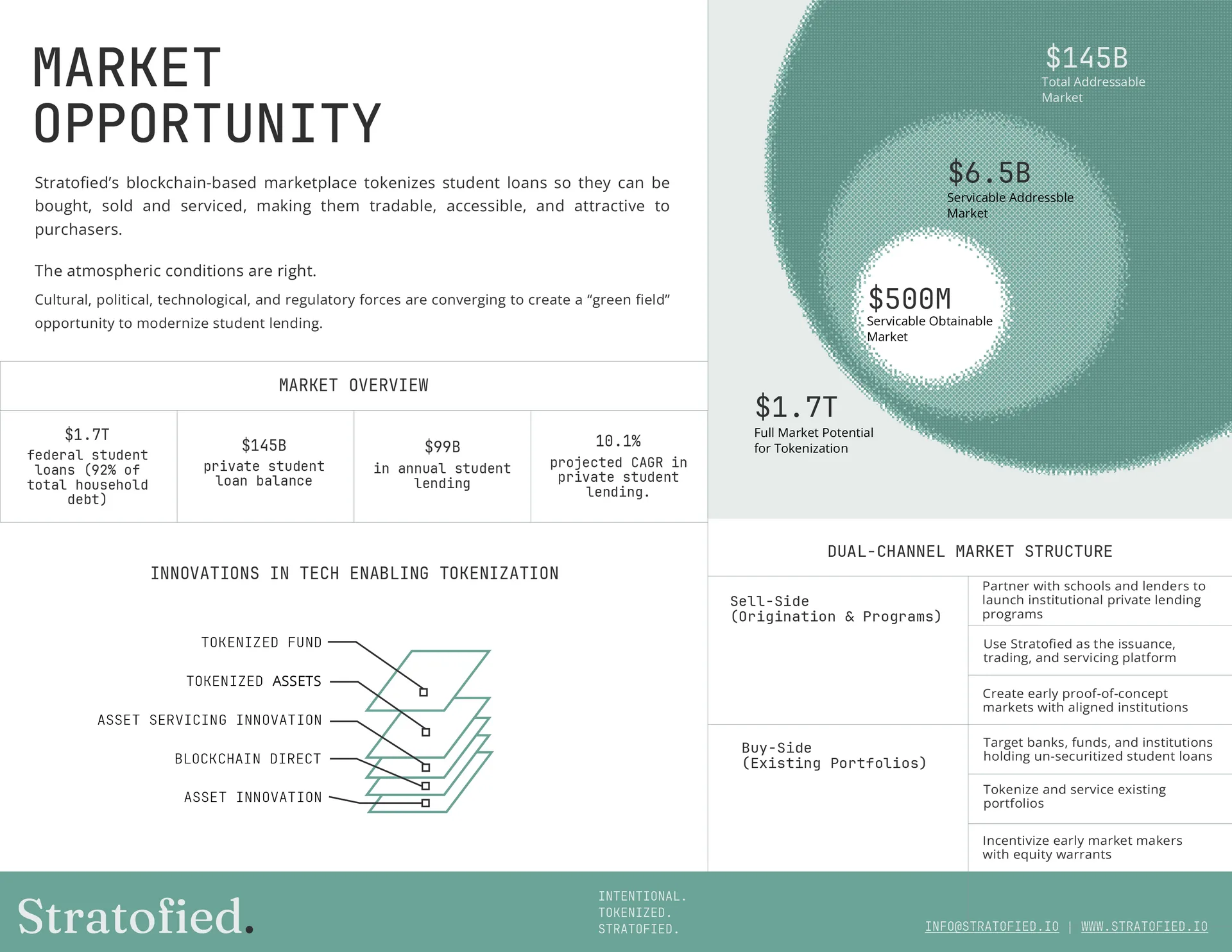
Who This Serves and Wy They Care
The platform creates value for multiple stakeholders who currently have no good options in the dysfunctional student loan market:
Lenders: Gain liquidity they’ve never had access to before, which means they can originate loans without being stuck holding them to maturity. This improves capital efficiency and allows them to lend more while managing risks better. A community bank or credit union that wants to support local students can originate loans and sell participation interests to investors, recycling capital into new lending instead of watching it sit on the balance sheet for 10-20 years. The process also avoids securitization, saving millions (or more) in costs incurred to bundle portfolios into asset-backed securities and sell to large institutional purchasers.
Investors: Receive access to an asset class with attractive risk-adjusted returns that’s been completely unavailable to anyone outside specialized institutional programs. With an intuitive user interface, you can build diversified portfolios based on specific criteria that matter to you: whether that’s supporting education at particular schools, backing students in certain fields, or just seeking yield from a non-correlated asset class.
Schools: Benefit from expanded financing options that don’t depend on dysfunctional federal programs. They can develop institutional lending programs where alumni, donors, or corporate partners provide student financing directly with returns that support the school’s mission.
Students: Benefit downstream through increased competition and better loan terms. When lenders have liquidity and can manage risk more effectively, they can offer lower rates than the current market where illiquidity premiums add 5-10% to borrowing costs. In the not-too-distant future, student borrowers will be able to customize their loan terms or collateralize loans with other digital assets.
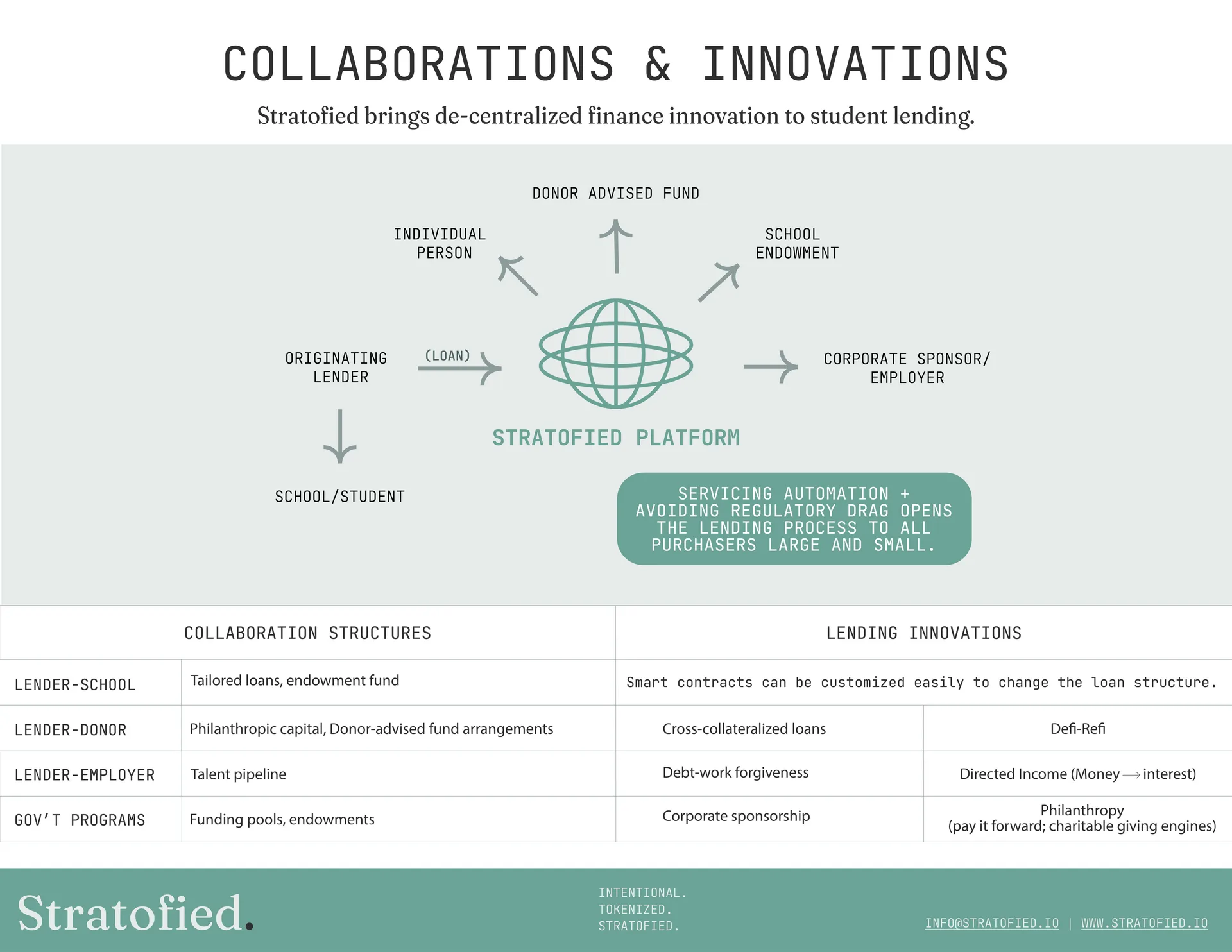
Why This Isn’t Vaporware
What separates Stratofied from typical blockchain projects is that they built the hard stuff first. They have marketplace mechanics that handle real transactions. They have servicer integrations that preserve borrower relationships. They have a legal framework that works within established loan participation structures. The tokenization layer enhances an operating business instead of being the business itself.
Three proof points that matter:
1. Legal framework: Using loan participation agreements that have existed for decades with clear precedent. Courts understand how they work; regulators know how to handle them, and market participants know what they’re getting.
2. Servicer integration: Platform integrates with existing loan servicers who continue handling payment processing, forbearance requests, default management, and regulatory compliance. The borrower's experience never changes.
3. Policy positioning: Stratofied published a major thought leadership piece in August 2025 titled “A Market in Need of a Marketplace: Unleashing Innovation in a New Era of Education Freedom” that lays out a comprehensive policy framework for transitioning from federal direct lending to market-based student finance.
A Market in Need of a Marketplace: 530.97 KB - PDF File - Download

The Policy Push
The timing aligns with the current administration’s stated goal of dismantling the Department of Education, which creates a policy window for alternative approaches to education finance. The paper makes a detailed case for why tokenization solves the practical problems that prevented previous privatization attempts, specifically the inability to create liquid markets for student loans without expensive securitization structures.
By tokenizing the federal portfolio using loan participation frameworks, you can enable fractional ownership and trading while preserving service relationships and borrower protections. The proposal includes specific steps like restoring financial health to the portfolio by ending forgiveness programs that encourage strategic default, converting performing loans to tokenized participations first to maximize taxpayer recovery, and creating market-based pricing that gives schools and degrees a “scorecard” through the interest rates their graduates can obtain.
The Infrastructure Behind the Marketplace
Here’s where the specialized infrastructure approach comes into play. Stratofied needed marketplace technology that could handle tokenized loan trading with institutional-grade execution quality but building that from scratch would take years and massive capital investment. Instead, they’re leveraging Liquid Mercury’s proven marketplace infrastructure through a white-label partnership.
The full infrastructure stack LM provides:
Marketplace infrastructure → Matching engine, order management systems, and client management built for institutional-grade execution.
White-labeled UI/UX → Branded front-end that presents under Stratofied identity while leveraging proven interface technology.
Core trading infrastructure → Execution quality and order routing that handles the actual trading mechanics with precision.
Third-party integrations → Seamless connectivity to servicer systems and external tooling that Stratofied’s operations require.
Financial infrastructure → Complete ledger systems, payment processing, CFO-level services, and custody integration that institutional participants demand.
Regulatory and compliance layer → Regulatory advisory and compliance enablement so Stratofied can focus on operations while staying compliant.
Tokenization and RWA rails → Asset tokenization capabilities and on-chain readiness that make Stratofied tokens functional, not just theoretical.
Enterprise backend → ERP systems and business intelligence tools that connect marketplace activity to operational reality.
Strategic services → Executive and business development support that helps Stratofied navigate institutional relationships.
The reason this full-stack approach matters are execution quality across every layer, not just the visible trading interface. Without proven financial infrastructure, you can’t handle institutional settlement requirements. Without regulatory frameworks, you can’t onboard serious allocators. Without enterprise backend integration, marketplace activity stays disconnected from physical operations. With institutional-grade technology handling every layer, you get the reliability that makes professional capital comfortable deploying at scale.
This is specialization done right. Stratofied focuses on what they do best, which is education finance expertise, service relationships, and policy positioning. LM provides the entire technology and operational backbone that turns loans into tradeable digital assets. Neither could build what the other does effectively, but together they create infrastructure that institutional allocators can actually use.
Why Now Matters:
Three catalysts converging:
1. Political pressure → The federal portfolio is failing so badly that even politicians who love government programs admit it needs fixing. The focus on dismantling the Department of Education creates a policy window for market-based solutions.
2. RWA maturation → Tokenization moving from hype to actual implementation as technology matures and regulatory frameworks clarify.
3. Capital allocation shift → Institutional capital actively seeking yield in alternative asset classes with scale, real cash flows, and enhanced operational efficiency.
Stratofied has timed their infrastructure build to meet this moment. They’ve spent years establishing the operational footprint and legal framework, which means they can layer on proven marketplace technology from a position of validated execution. The hard part in student lending is the legal structure and servicer coordination, not the trading infrastructure or regulatory navigation, so partnering for the complete technology stack including compliance enablement and strategic business development support while focusing on education finance operations makes complete sense.

This is infrastructure development done right. Build operational excellence first, prove you can execute at scale, then integrate best-in-class technology for trading, settlement, compliance, and institutional connectivity. That’s how you create something institutional allocators can actually use.
What To Watch
Partnership signals:
- Which lenders publicly commit to listing loans on the platform.
- Whether state education agencies explore using Stratofied infrastructure.
- These signal that operational scale is creating enough value for deeper integration.
Token mechanics and structure:
- How Stratofied structures participation in loan economics.
- Investment vehicles for institutional allocators vs loan-backed positions with defined yields.
- Marketplace design for fractional ownership of loan pools.
- The structure reveals whether this is serious capital markets integration or tokenization theater.
Marketplace performance:
- Trading volume and liquidity metrics once Stratofied goes live.
- Settlement reliability and execution quality meeting institutional standards.
- Whether the business intelligence layer provides the transparency allocators need for informed deployment.
- Whether economics make sense for allocators and loan quality lives up to promises.
Bottom Line
Watch the economics. If Stratofied demonstrates consistent recovery of the illiquidity premium while maintaining servicer integration and borrower experience quality, they become infrastructure for the industry needs. The complete technology stack, from trading systems to financial infrastructure to compliance frameworks to strategic business development, makes participation accessible to institutional capital. But the foundation is operational execution in a massive market currently destroying billions in value annually. Both pieces have to work for this to scale.
Latest articles
...
A Market in Need of a Marketplace: Unleashing Innovation in a New Era of Education Freedom
Stratofied offers customizable end-to-end lending solutions in an off-the-shelf product style. Our platform also plugs into existing programs for a hassle-free transition.
Read more

Tokenization 101:
Stratofied offers customizable end-to-end lending solutions in an off-the-shelf product style. Our platform also plugs into existing programs for a hassle-free transition.
Read more